Global Head of Statistical Programming · Bayer AG

Data doesn't transform
organizations.

People do.

PHUSE Board Member Data Caterer™ 29 Years in Pharma

If someone gives them a frame worth thinking in.

I lead one of pharma's most complex statistical programming functions. Every day, my teams wrestle with the same tension you do: between the pressure to deliver and the ambition to lead differently.

Read my latest thinking 
Sascha Ahrweiler
Sascha Ahrweiler
Global Head · Statistical Programming
At Bayer
12+
years
Career
29
years
PHUSE
15+
years
CDISC SDTM/ADaM Regulatory SAS · R DSO Data Caterer™
Statistical Programming Clinical Data Science Pharma Leadership PHUSE Board Data Caterer™ Dynamic Shared Ownership SCE Modernization Regulatory Submissions

The Data Caterer™

A model for the evolution of statistical programmers into strategic data professionals — from executing tasks to orchestrating decisions across the pharma value chain.

The Past
The Line Cook
Receives orders. Executes to spec. Technically proficient, but disconnected from the why. Data is a deliverable — produced, handed over, forgotten. The role is defined by the task, not the question behind it.
The Destination
The Data Caterer™
Knows the guest before they sit down. Curates, governs, and orchestrates data across the full pharma value chain — from protocol design to post-approval evidence. Not just execution: experience, wisdom, and the ability to build lasting knowledge.
The Pharma Value Chain — The Data Caterer™ plays all along it
01
Non-clinical Research
Safety signals · First hypotheses
02
Early Clinical Development
Phase I/II · First in human
03
Pivotal Development
Phase III · Efficacy & safety at scale
04
Regulatory Submission
Evidence packages · Approval
05
Post-Approval
Lifecycle management · Label updates
06
Commercial
Real-world evidence · Market access

Each phase carries distinct risk — safety, efficacy, regulatory acceptance. The Data Caterer's unique value is continuity: the same data domain expertise, regulatory fluency, and knowledge architecture operating across every stage — learning from the past to inform the future.

Concept 01
Well-Governed Drift
Doing the right things, in the right process, toward the wrong destination. The hidden risk that perfect governance cannot protect against — only purpose can.
Concept 02
Dynamic Shared Ownership
The operating model at Bayer that replaces hierarchical assignment with dynamic, purpose-driven ownership. Think specialized restaurants — each Data Caterer focused on a distinct product domain — united through shared communities of practice where craft evolves collectively.
Concept 03
Effectiveness Over Efficiency
Efficiency is what AI will give us. Effectiveness is what we have to choose. In pharma, where the wrong decision costs lives and the right one saves them, that choice is the job.

Keynotes that make complex ideas
worth thinking in

Available for keynotes, workshops, and panels at industry conferences and leadership forums — globally.

Talk 02
Beyond the Toolbox — What the Open Source vs. Proprietary Debate Is Distracting Us From
The SAS vs. R vs. Python argument is real — but it's a proxy war. Every hour spent debating platforms is an hour not spent on the harder question: what value does our function actually create? This talk uses the Data Caterer lens to reframe technology decisions as downstream choices — dependent on a clarity of purpose that most organizations haven't yet established.
For: Executive forums · Pharma analytics leadership · PHUSE/CDISC conferences
Talk 03
Earned Wisdom — Personal Knowledge Management for Pharma Leaders
From Obsidian to Readwise to structured reflection — a PKM system built for knowledge professionals who lead in complex environments. How private reading becomes public contribution, and why the management of what you know is itself a strategic capability in the age of AI.
For: Leadership development · Professional growth events · Knowledge management forums
Interested in a keynote or workshop?
Available for conferences, leadership forums, and industry events globally.
Get in touch →

Publications, presentations & the books
that shaped how I think

The intellectual trail connecting private reading to public contribution — from PHUSE papers to keynotes, from Obsidian notes to stage moments.

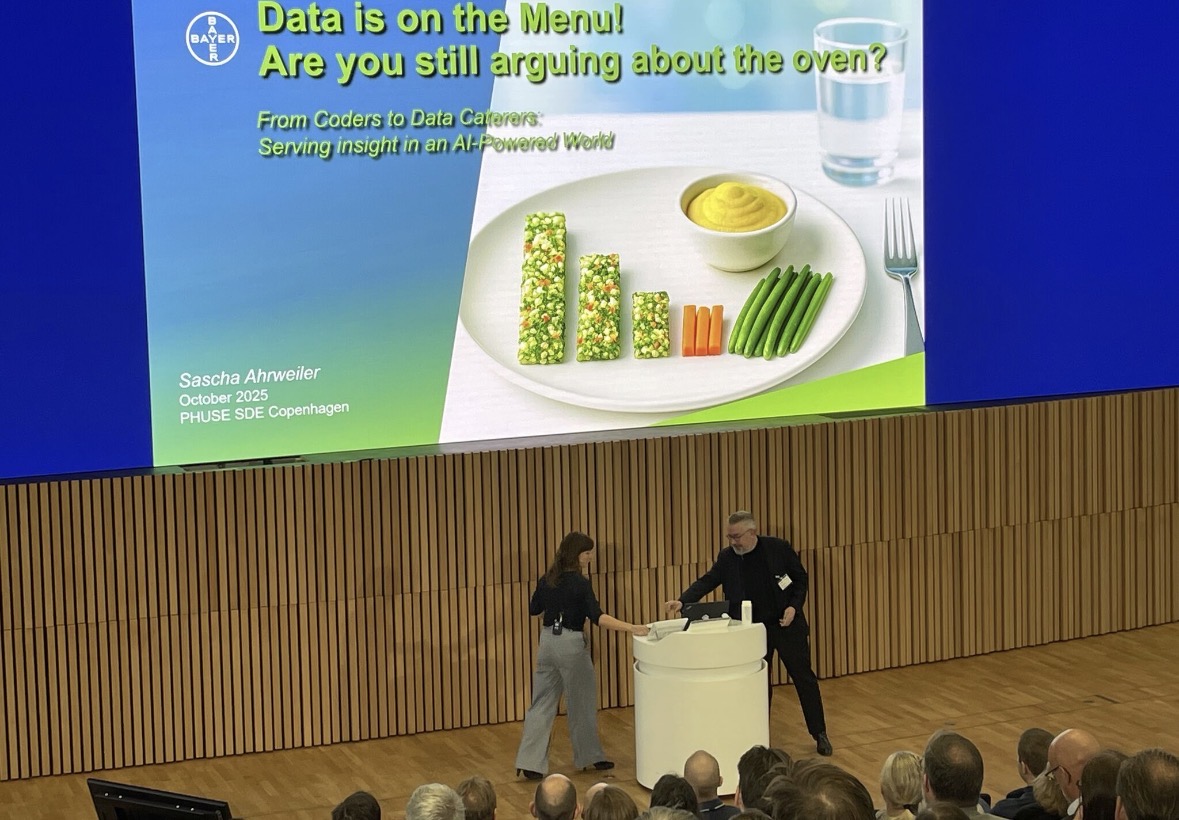
Sascha Ahrweiler presenting at PHUSE SDE Copenhagen
PHUSE Paper · 2011
Training Statistical Programmers on SAP Review Skills
PHUSE EU Connect · Brighton, UK  ·  Paper ↗  ·  Slides ↗
A structured framework for statistical programmers to review a Statistical Analysis Plan — enabling genuine analytical engagement rather than compliance scanning. My first paper. The room was standing-room only. It was the moment I learned I had something worth saying. Years later, peers told me they used it to build SAP review training programs. It was also — unexpectedly — plagiarized at the 2015 inaugural PHUSE Connect in Raleigh.
PHUSE Paper · 2014
Managing the Change — Evolving Statistical Programmers to Clinical Data Scientists
PHUSE EU Connect · London, UK  ·  Paper ↗  ·  Slides ↗
The evolution of statistical programmers toward data scientists — described through the legacy of the function and shaped partly by mentor Jim Johnson's input. Written in my last days at UCB, presented under my new Bayer role. Many of the capabilities described here are still core to what I call the Data Caterer today.
PHUSE Paper · 2015
FDA Review Principles Applied to CRO Oversight
PHUSE EU Connect · Vienna, Austria  ·  Paper ↗  ·  Slides ↗
Born from Bayer's outsourcing initiatives — a framework for how internal statistical programmers should conduct analytical reviews of CRO-delivered artifacts, drawing a parallel to FDA reviewer methodology. Looking back in 2026, this is more relevant than ever. It is, essentially, one core skill of a Data Caterer working with externally created artifacts.
PHUSE Paper · 2019
Career (and Life) Improvements Through Self-quantifying Biohacking Techniques
PHUSE EU Connect · Amsterdam, Netherlands  ·  Paper ↗  ·  Slides ↗
A 360-degree framework of self-optimization and biohacking techniques I practiced to improve health, focus, and performance. In retrospect, I overdid it. COVID disrupted many of the practices. Today the Oura ring is the only technical gadget that remains from that period — and the habit of tracking progress still holds.
PHUSE Workshop · 2021
Data Science Hands-on Workshop: Data Storytelling
PHUSE US Connect · Virtual  ·  Slides ↗  ·  Recording ↗
Developed during the quiet of COVID lockdowns, this workshop brought data storytelling to life through Knaflic, Freytag's Pyramid, and years of practice. The virtual format limited the energy, but the content found a longer life on PHUSE Education. A workshop that would have been even better in person — and still might be.
PHUSE Paper · 2023
Stoic OS: Installing Ancient Wisdom for Holistic Leadership in the Digital World
PHUSE EU Connect · Birmingham, UK  ·  Paper ↗  ·  Slides ↗
Stoicism came into my life during COVID and has stayed. This paper maps stoic principles onto the demands of leadership in an ever-shifting world. "Stoic OS" names it precisely: just as an operating system provides foundational rules, stoic philosophy provides the foundational rules for a calm, decisive mind.
PHUSE Paper · 2024
Future-Proofing Clinical Data Sciences: The Pivotal Role of Therapeutic Area Proficiency
PHUSE US Connect · Bethesda, MD  ·  Paper ↗  ·  Slides ↗
My first paper co-authored with generative AI — and fittingly, a paper about how AI accelerates learning in a Therapeutic Area. The argument: writing an educational article about a TA is itself the best method of knowledge creation. Knowing in order to explain, rather than explaining what you already know. TA proficiency is non-negotiable for the Data Caterer.
PHUSE Paper · 2025
From Overload to Insight: Personal Knowledge Management for Clinical Data Scientists in the Age of Generative AI
PHUSE EU Connect · Hamburg, Germany  ·  Paper ↗  ·  Slides ↗
This is the actual foundation of the Data Caterer story. Before you can orchestrate data for others, you have to manage the constant information overflow yourself. Inspired by Tiago Forte's "Building a Second Brain," this paper offers a PKM system for knowledge professionals operating under cognitive overload. Sold-out room. Excellent feedback. Another topic that resonates far beyond our industry.
PHUSE SDE Copenhagen 2025
Keynote · 2025
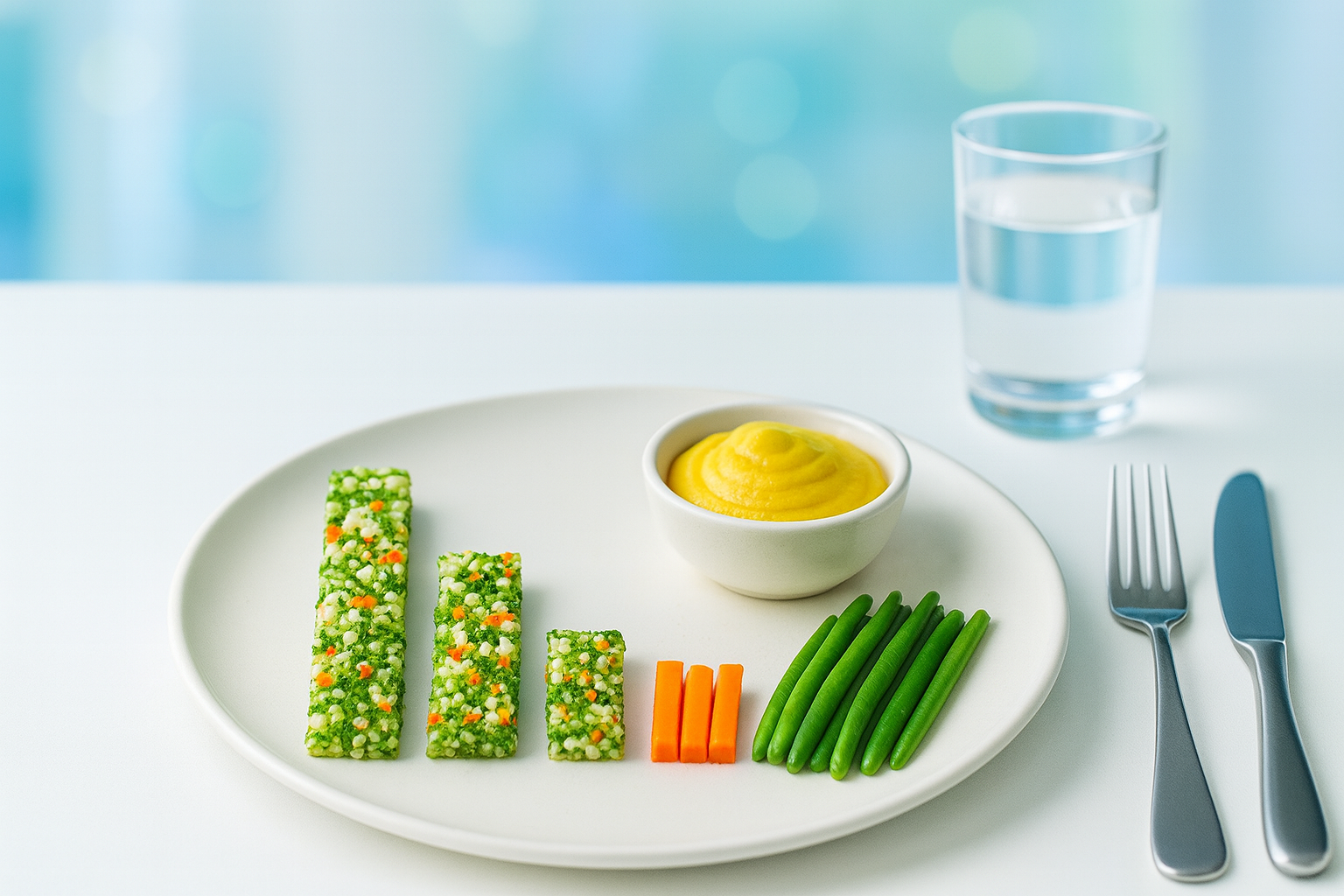
Data Is on the Menu – Are You Still Arguing About the Oven?
PHUSE SDE · Copenhagen, Denmark  ·  Slides ↗
The keynote that launched the Data Caterer vision publicly — at Novo Nordisk's invitation, following a viral LinkedIn debate about SAS vs. R that missed the point entirely. What started as a tool discussion ended in a visionary agenda. Controversial conversations in the breaks. The room wasn't ready for the argument to end — but it needed to hear it.
PHUSE APAC Connect Hyderabad 2026
Conference Presentation · 2026
From Vision to Implementation: Building the Data Caterer's Kitchen at Bayer
PHUSE APAC Connect · Hyderabad, India  ·  Slides ↗
Co-presented with Olivier Bouchard (SAS) at the inaugural PHUSE APAC Connect. Walking the talk: what Bayer has actually built toward the Data Caterer vision. The core message: this transformation is 80% mindset and 20% technology. SAS and Bayer are aligned on both.
PHUSE US Connect Austin 2026
Conference Presentation · 2026
The Clinical Data Lake: Empowering the Data Caterer Vision with Veeva, SAS and Open Source
PHUSE US Connect · Austin, Texas  ·  Slides ↗  ·  Paper ↗
The three technical pillars of Bayer's ecosystem: Veeva, the Databricks-based Clinical Data Lake, and the SAS Viya SCE. Co-authored with Holger Dach (Bayer). The Data Caterer vision continues to resonate — and the implementation is now concrete enough to make the case on the ground.
SAS Innovate on Tour Frankfurt 2026
Upcoming · 2026
SAS Innovate on Tour — Frankfurt
SAS Innovate on Tour 2026 · Frankfurt, Germany  ·  Event ↗
The full Data Caterer story, including the building blocks in use with SAS: Analytics Leadership Programme, Education Platform, and SAS Viya. The conversation about how established platforms anchor transformation — rather than resist it — continues.
SAS Innovate on Tour Liverpool 2026
Upcoming · 2026
SAS Innovate on Tour — Liverpool
SAS Innovate on Tour 2026 · Liverpool, England  ·  Event ↗
A continuation of the Frankfurt session — same story, different room. Each iteration sharpens the narrative. Liverpool will be the latest iteration of a conversation that started in Copenhagen and has been growing ever since.
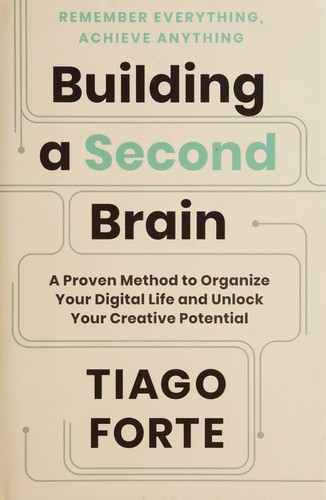
Building a Second Brain cover
Book Reflection
Building a Second Brain — Tiago Forte
PKM · Knowledge Systems
The book behind the PKM paper and, indirectly, the Data Caterer story. Forte's CODE method (Capture, Organize, Distill, Express) gave structure to what I'd been doing intuitively in Obsidian. The core insight: your best thinking shouldn't live only in your head — it should be externalized, connected, and reusable.
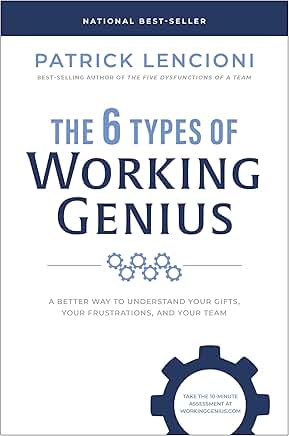
The 6 Types of Working Genius cover
Book Reflection
The 6 Types of Working Genius — Patrick Lencioni
Team Design · Leadership
One of the most practically useful team frameworks I've encountered. The six types — Wonder, Invention, Discernment, Galvanizing, Enablement, Tenacity — explain not just what people do well but what energizes versus drains them. Changed how I think about building teams and assigning work in the DSO model.
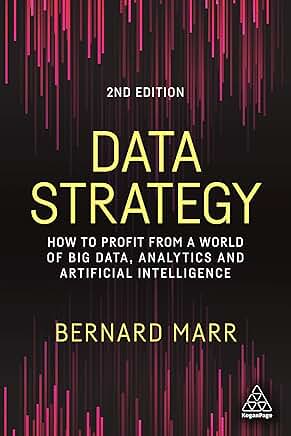
Data Strategy cover
Book Reflection
Data Strategy — Bernard Marr
Data · Strategy
A grounding text for thinking about data as an organizational asset rather than a byproduct of process. Gave me language for conversations with senior stakeholders who need to understand why data governance, architecture, and quality are strategic decisions — not just technical ones.
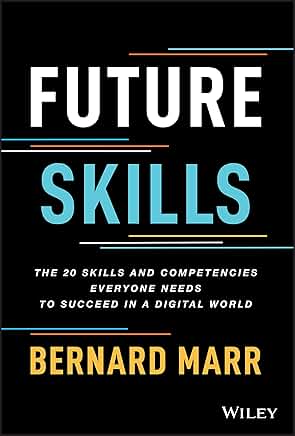
Future Skills cover
Book Reflection
Future Skills — Bernard Marr
Workforce · Adaptation
Adaptability. Ethics. Lifelong Learning. The three themes that cut through this book and directly into how I think about workforce evolution. The Data Caterer isn't just a new role — it's a new way of being a professional. This book provides the backdrop for understanding why.
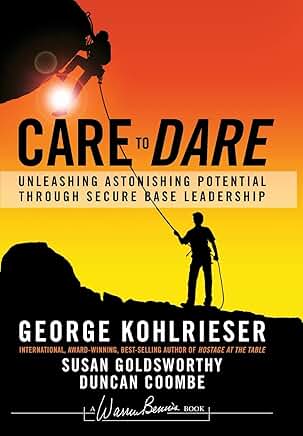
Care to Dare cover
Book Reflection
Care to Dare — George Kohlrieser
Leadership · Psychological Safety
Hostage negotiation principles applied to leadership. The insight that you can only challenge people you genuinely care about — that daring without caring is just aggression — reshuffled how I think about accountability, feedback, and high-performance team culture.
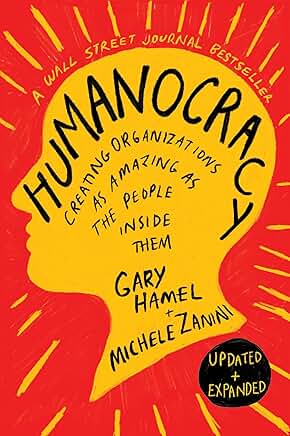
Humanocracy cover
Book Reflection
Humanocracy — Gary Hamel & Michele Zanini
Org Design · Bureaucracy
The case against bureaucracy as organizational default — and a vision for what organizations look like when human ingenuity is the organizing principle. Resonates directly with the move from hierarchical assignment models toward Dynamic Shared Ownership. The argument isn't anti-structure; it's anti-default.
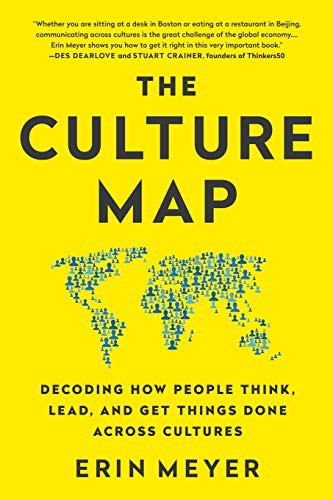
The Culture Map cover
Book Reflection
The Culture Map — Erin Meyer
Cross-Cultural · Global Leadership
Essential reading for anyone leading global teams. Meyer's eight-scale model — communication, trust, scheduling, and more — gave me far more precise vocabulary for understanding why the same message lands differently in Hyderabad, Austin, and Hamburg.
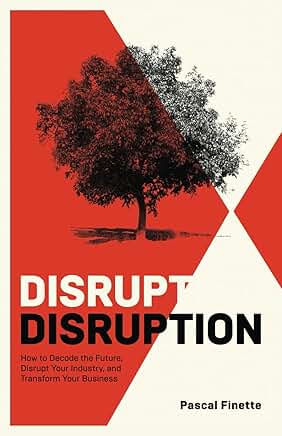
Disrupt Disruption cover
Book Reflection
Disrupt Disruption — Pascal Finette
Transformation · Future of Work
Disruption doesn't require destruction. Finette makes the case that the most durable transformations work with existing structures rather than against them — and that the real enemy of change is not resistance but impatience. A sharp counterweight to the disruption-as-heroism narrative, and a useful lens for leading change inside a large, regulated organization.
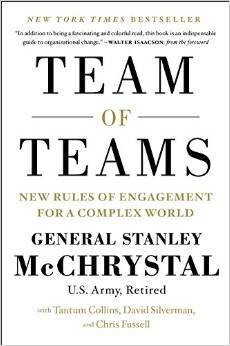
Team of Teams cover
Book Reflection
Team of Teams — General Stanley McChrystal
Org Design · Shared Consciousness
McChrystal's account of transforming military command to fight an adaptive enemy. The concept of 'shared consciousness' — where every node has enough context to make good decisions without waiting for orders — maps directly onto DSO. Hierarchy doesn't scale against complexity. Networks do.
The Ride of a Lifetime cover
Book Reflection
The Ride of a Lifetime — Robert Iger
Leadership · Long-Range Thinking
Inspiring. Practical. Humane. The rare executive book that doesn't flatten complexity into platitudes. Iger's approach to courage, curiosity, and optimism as operational principles — not just values on a wall — gave me a lot to think about in terms of how I model leadership for my team.
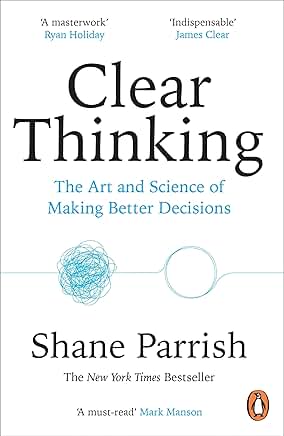
Clear Thinking cover
Book Reflection
Clear Thinking — Shane Parrish
Decision-Making · Mental Clarity
Defaults. Discipline. Decisions. Parrish's argument: most bad decisions happen not during deliberation but before it — when automatic defaults take over. Learning to identify which defaults are running, and override the bad ones deliberately, is the real work of clear thinking. Immediately applicable.
The Great Mental Models, Vol. 1 cover
Book Reflection
The Great Mental Models, Vol. 1 — Shane Parrish
Mental Models · First Principles
Timeless thinking tools — inversion, first principles, second-order effects, the map-territory distinction. This book doesn't just add knowledge; it changes the structure of how you think. I return to specific chapters when facing particularly complex problems.
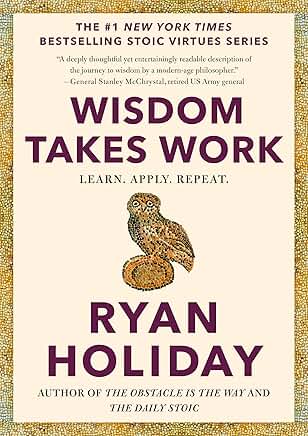
Wisdom Takes Work cover
Book Reflection
Wisdom Takes Work — Ryan Holiday
Stoic Virtues Series · Philosophy in Practice
Learn. Apply. Repeat. The fourth and final virtue in Holiday's Stoic series is the one all others depend on — and the hardest to earn. Wisdom isn't a destination or a credential; it is the accumulated result of staying curious, questioning your defaults, and being willing to be wrong. The book I keep returning to when the strategic pressure is loudest.

Links lead to independent local bookstores — bookshop.org (US & UK) and genialokal.de (DE). No affiliate links.

Five movements through
a 29-year career

Sascha Ahrweiler
Movement I

The Question

The question that has followed me through my entire career sounds almost too simple to say out loud: why are we doing this?

Not why we capture data. Not why we run clinical trials. But why — really why. There is a patient at the end of every dataset we produce. A person waiting for a therapy that may or may not exist because of decisions made on the basis of data we shaped.

Most of our industry is extraordinarily good at the how. The processes, the standards, the governance — we've built remarkable machinery. And now AI is making that machinery faster than we ever imagined. But speed is not the point. Efficiency was never the point.

Effectiveness is. Doing the right things — for the right reasons — with enough clarity to know the difference. That question changes how I lead. And it's the reason I care so deeply about what statistical programming functions are capable of becoming.

Movement II

Where It Comes From

It started with a boxplot I couldn't explain.

My first encounter with clinical data was as a student assistant at the Institute for Medical Statistics in Düsseldorf — tasked with visualizing measurements from a dental implant study using SAS. I produced the plot. It was technically correct. And it made no sense whatsoever.

My supervisor told me as much. So I sat down, studied the variables, understood how they were collected and what they actually measured. Only then could I show something meaningful. That moment planted a seed I didn't recognize at the time: data without understanding is just noise dressed up as output.

Years later, the seed became a conviction. I was interviewing for my first move from CRO work into pharma. The Head of R&D asked what the clinical rationale was for the studies I'd worked on. I had nothing. I had processed the data. I had never read the protocol.

I left that interview deeply dissatisfied — not with them, but with myself. So I went home and read every protocol I could find. I spent the next year closing the gap — deliberately, methodically. When I finally made the move to Schwarz Pharma, it was because I felt ready. On my own terms.

That question followed me from Düsseldorf over Monheim to Wuppertal, from CRO to Schwarz Pharma to UCB to Bayer. It's the reason I believe statistical programming is not a support function, but the intelligence layer of drug development.

What is Clinical Trial Programming?

A clinical trial is a rigorously controlled scientific study that tests whether a new drug, treatment, or intervention is safe and effective in human patients — before it is approved for widespread use. Every approved medicine you or your family has taken went through this process.

Clinical trials generate enormous volumes of structured data: patient demographics, dosing records, laboratory measurements, safety events, efficacy outcomes. This data must be captured, standardized, validated, and transformed into formats that regulatory agencies — the FDA, EMA, and others — can review and rely upon to make approval decisions that affect millions of people.

Statistical programming is the discipline that does this work: transforming raw clinical data into analysis-ready datasets and the tables, listings, and figures that populate a regulatory submission. It sits at the intersection of data science, medical knowledge, and regulatory precision — and a single error can delay or derail a drug that patients are waiting for.

Movement III

The Connecting Arc

But no transformation happens in isolation — and mine didn't either.

In 2013, I chaired the PHUSE conference in Brussels. The first ever sold-out PHUSE conference. I was leading a program committee of over thirty people — almost all of them more experienced than I was at the time. Heads of statistical programming functions, subject matter experts from across the industry.

The theme I chose was Patient Centricity. Not as a slogan — as a lens. Leading that committee taught me something I've carried ever since: you don't lead experienced people through authority. You lead them through purpose. Give people a WHY worth working toward — and they will bring more than you asked for.

PHUSE is where private convictions become collective momentum. Where I've learned that the shift I'm trying to make inside Bayer is happening — in different forms, at different speeds — across the entire industry. That realization changed how I lead. And how I think about what's possible.

What is PHUSE?

PHUSE — the Pharmaceutical Users Software Exchange — is the global professional community for clinical data science. Founded in 2004, it brings together statisticians, statistical programmers, data managers, and regulators from pharma companies, CROs, academic institutions, and health agencies worldwide.

PHUSE connects over 5,000 members across more than 50 countries. Its annual conferences, working groups, and educational initiatives shape the standards and practices that govern how clinical trial data is structured, analyzed, and submitted to regulators. When the FDA and EMA align on data standards, PHUSE is often part of the conversation that led there.

For those working in clinical data science, PHUSE is not just a conference — it is the professional home where careers are shaped, ideas are tested, and the future of the discipline is written.

Visit phuse.global ↗
Movement IV

What I Believe

A few things I've come to believe — earned through experience, not arrived at through theory:

Data without understanding is just noise dressed up as output. I learned that from a boxplot in Düsseldorf. I haven't forgotten it.
You don't lead experienced people through authority. You lead them through purpose. The moment you lose sight of the WHY — the patient, the therapy, the decision that matters — you are no longer leading. You are just managing.
Efficiency is what AI will give us. Effectiveness is what we have to choose. And in an industry where the wrong decision costs lives and the right one saves them, that choice is not a luxury. It is the job.
Statistical programming is not a support function. It is the intelligence layer of drug development. The sooner our industry treats it that way, the better the decisions we will make — for the patients waiting at the end of every dataset we produce.
And the biggest risk we face is not bad data. It is well-governed drift — doing the right things, in the right process, toward the wrong destination.
Movement V

Beyond the Function

Sascha Ahrweiler

I live near Krefeld — close enough to Düsseldorf, the city that shaped me, that I still visit regularly. Close enough to feel connected. Far enough to think clearly.

At home, it's Telse and me, our dog, and a house that feels a little quieter since our two daughters found their own way in the world. I ride gravel, follow the Krefeld Pinguine with the devotion of a season ticket holder, and read — a lot. Not as a hobby. As a practice.

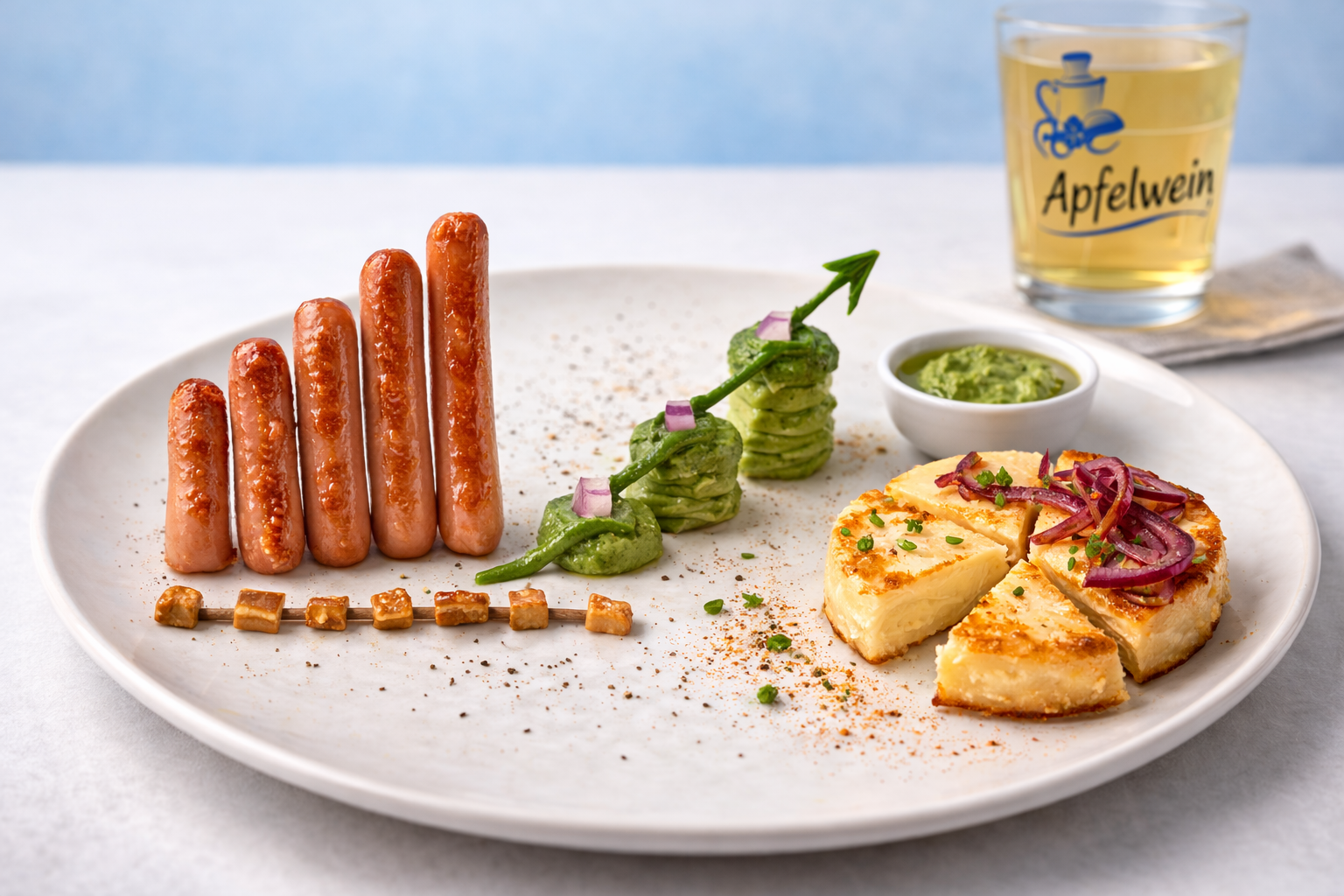
I'm also a certified barista — which means the kitchen metaphor at the heart of the Data Caterer™ framework isn't borrowed. It's lived. Food and coffee are serious passions: the craft of selecting quality ingredients, understanding what someone actually craves, and transforming raw material into an experience worth having. That's not a metaphor for data work. It's the same instinct, applied in a different medium.

Data Caterer™ Ecosystem
AI Ghostwriter
A writing analysis and improvement tool for professionals in regulated industries. Aggregates observable signals across seven dimensions into a composite score — then provides passage-level improvement suggestions with annotated document downloads.
Seven-dimension composite scoring (AI likelihood, structure, vocabulary, hedging, novelty, citation quality, coherence) Passage-level improvement suggestions with annotated DOCX/PDF downloads PHUSE archive comparison across 200+ indexed papers (2017–2025) Defensible framework — not binary detection, but structured signal analysis
DOCX · PDF Writing Quality AI Detection PHUSE Archive
Data Caterer™ Ecosystem
SAP Review Checker
A six-dimension weighted scoring framework for Statistical Analysis Plan quality assessment — based on the Ahrweiler IS01 framework, ICH E9, ICH E9(R1), ICH E6(R3), and the Gamble et al. JAMA checklist. Work through each dimension's checklist and receive a structured quality score.
Six weighted dimensions: Correctness, Consistency, Completeness, Technical Details, Appropriateness, Estimand Alignment ICH E9(R1) estimand compliance checking with per-ICE strategy validation Maturity scoring from Inadequate (1) to Exemplary (5) per dimension Downloadable structured review report (HTML) with dimension scores and reviewer notes
SAP · PDF · DOCX ICH E9(R1) Estimands CDISC ADaM

If something here resonated —
or challenged your thinking
I'd like to hear from you.

Whether it's a speaking inquiry, a conversation about the Data Caterer™ framework, or a shared conviction about where statistical programming is headed — reach out. I respond personally.